Physics (from Ancient Greek: φύσις physis "nature") is a natural science that involves the study of matter and its motion through space and time, along with related concepts such as energy and force. More broadly, it is the general analysis of nature, conducted in order to understand how the universe behaves.
Physics is one of the oldest academic disciplines, perhaps the oldest through its inclusion of astronomy. Over the last two millennia, physics was a part of natural philosophy along with chemistry, certain branches of mathematics, and biology, but during the Scientific Revolution in the 17th century, the natural sciences emerged as unique research programs in their own right. Physics intersects with many interdisciplinary areas of research, such as biophysics and quantum chemistry, and the boundaries of physics are not rigidly defined. New ideas in physics often explain the fundamental mechanisms of other sciences, while opening new avenues of research in areas such as mathematics and philosophy.
Physics also makes significant contributions through advances in new technologies that arise from theoretical breakthroughs. For example, advances in the understanding of electromagnetism or nuclear physics led directly to the development of new products which have dramatically transformed modern-day society, such as television, computers, domestic appliances, and nuclear weapons; advances in thermodynamics led to the development of industrialization; and advances in mechanics inspired the development of calculus.
History
As noted below, the means used to understand the behavior of natural phenomena and their effects evolved from philosophy, progressively replaced by natural philosophy then natural science, to eventually arrive at the modern conception of physics.
Natural philosophy has its origins in Greece during the Archaic period, (650 BCE – 480 BCE), when Pre-Socratic philosophers like Thales refused supernatural, religious or mythological explanations for natural phenomena and proclaimed that every event had a natural cause. They proposed ideas verified by reason and observation and many of their hypotheses proved successful in experiment, for example atomism.
Classical physics became a separate science when early modern Europeans used these experimental and quantitative methods to discover what are now considered to be the laws of physics. Kepler, Galileo and more specifically Newton discovered and unified the different laws of motion. Experimental physics had its debuts with experimentation concerning statics by medieval Muslim physicists like al-Biruni and Alhazen. During the industrial revolution, as energy needs increased, so did research, which led to the discovery of new laws in thermodynamics, chemistry and electromagnetics.
Modern physics started with the works of Max Planck in quantum theory and Einstein in relativity, and continued in quantum mechanics pioneered by Heisenberg, Schrödinger and Paul Dirac.
Philosophy
In many ways, physics stems from ancient Greek philosophy. From Thales' first attempt to characterize matter, to Democritus' deduction that matter ought to reduce to an invariant state, the Ptolemaic astronomy of a crystalline firmament, and Aristotle's book Physics (an early book on physics, which attempted to analyze and define motion from a philosophical point of view), various Greek philosophers advanced their own theories of nature. Physics was known as natural philosophy until the late 18th century.
By the 19th century physics was realized as a discipline distinct from philosophy and the other sciences. Physics, as with the rest of science, relies on philosophy of science to give an adequate description of the scientific method. The scientific method employs a priori reasoning as well as a posteriori reasoning and the use of Bayesian inference to measure the validity of a given theory.
The development of physics has answered many questions of early philosophers, but has also raised new questions. Study of the philosophical issues surrounding physics, the philosophy of physics, involves issues such as the nature of space and time, determinism, and metaphysical outlooks such as empiricism, naturalism and realism.
Many physicists have written about the philosophical implications of their work, for instance Laplace, who championed causal determinism, and Erwin Schrödinger, who wrote on quantum mechanics. The mathematical physicist Roger Penrose has been called a Platonist by Stephen Hawking, a view Penrose discusses in his book, The Road to Reality. Hawking refers to himself as an "unashamed reductionist" and takes issue with Penrose's views.
Core theories
Though physics deals with a wide variety of systems, certain theories are used by all physicists. Each of these theories were experimentally tested numerous times and found correct as an approximation of nature (within a certain domain of validity). For instance, the theory of classical mechanics accurately describes the motion of objects, provided they are much larger than atoms and moving at much less than the speed of light. These theories continue to be areas of active research, and a remarkable aspect of classical mechanics known as chaos was discovered in the 20th century, three centuries after the original formulation of classical mechanics by Isaac Newton (1642–1727).
These central theories are important tools for research into more specialized topics, and any physicist, regardless of his or her specialization, is expected to be literate in them. These include classical mechanics, quantum mechanics, thermodynamics and statistical mechanics, electromagnetism, and special relativity.
Classical physics
Classical physics includes the traditional branches and topics that were recognized and well-developed before the beginning of the 20th century—classical mechanics, acoustics, optics, thermodynamics, and electromagnetism. Classical mechanics) is concerned with bodies acted on by forces and bodies in motion and may be divided into statics (study of the forces on a body or bodies at rest), kinematics (study of motion without regard to its causes), and dynamics (study of motion and the forces that affect it); mechanics may also be divided into solid mechanics and fluid mechanics (known together as continuum mechanics), the latter including such branches as hydrostatics, hydrodynamics, aerodynamics, and pneumatics. Acoustics, the study of sound, is often considered a branch of mechanics because sound is due to the motions of the particles of air or other medium through which sound waves can travel and thus can be explained in terms of the laws of mechanics. Among the important modern branches of acoustics is ultrasonics, the study of sound waves of very high frequency beyond the range of human hearing. Optics, the study of light, is concerned not only with visible light but also with infrared and ultraviolet radiation, which exhibit all of the phenomena of visible light except visibility, e.g., reflection, refraction, interference, diffraction, dispersion, and polarization of light. Heat is a form of energy, the internal energy possessed by the particles of which a substance is composed; thermodynamics deals with the relationships between heat and other forms of energy. Electricity and magnetism have been studied as a single branch of physics since the intimate connection between them was discovered in the early 19th century; an electric current gives rise to a magnetic field and a changing magnetic field induces an electric current. Electrostatics deals with electric charges at rest, electrodynamics with moving charges, and magnetostatics with magnetic poles at rest.

Modern physics
Classical physics is generally concerned with matter and energy on the normal scale of observation, while much of modern physics is concerned with the behavior of matter and energy under extreme conditions or on the very large or very small scale. For example, atomic and nuclear physics studies matter on the smallest scale at which chemical elements can be identified. The physics of elementary particles is on an even smaller scale, as it is concerned with the most basic units of matter; this branch of physics is also known as high-energy physics because of the extremely high energies necessary to produce many types of particles in large particle accelerators. On this scale, ordinary, commonsense notions of space, time, matter, and energy are no longer valid.
The two chief theories of modern physics present a different picture of the concepts of space, time, and matter from that presented by classical physics. Quantum theory is concerned with the discrete, rather than continuous, nature of many phenomena at the atomic and subatomic level, and with the complementary aspects of particles and waves in the description of such phenomena. The theory of relativity is concerned with the description of phenomena that take place in a frame of reference that is in motion with respect to an observer; the special theory of relativity is concerned with relative uniform motion in a straight line and the general theory of relativity with accelerated motion and its connection with gravitation. Both quantum theory and the theory of relativity find applications in all areas of modern physics.
Relation to other fields
Prerequisites
Mathematics is the language used for compact description of the order in nature, especially the laws of physics. This was noted and advocated by Pythagoras, Plato, Galileo, and Newton.
Physics theories use mathematics to obtain order and provide precise formulas, precise or estimated solutions, quantitative results and predictions. Experiment results in physics are numerical measurements. Technologies based on mathematics, like computation have made computational physics an active area of research.
The distinction between mathematics and physics is clear-cut, but not always obvious, especially in mathematical physics.
Ontology is a prerequisite for physics, but not for mathematics. It means physics is ultimately concerned with descriptions of the real world, while mathematics is concerned with abstract patterns, even beyond the real world. Thus physics statements are synthetic, while math statements are analytic. Mathematics contains hypotheses, while physics contains theories. Mathematics statements have to be only logically true, while predictions of physics statements must match observed and experimental data.
The distinction is clear-cut, but not always obvious. For example, mathematical physics is the application of mathematics in physics. Its methods are mathematical, but its subject is physical. The problems in this field start with a "math model of a physical situation" and a "math description of a physical law". Every math statement used for solution has a hard-to-find physical meaning. The final mathematical solution has an easier-to-find meaning, because it is what the solver is looking for.
Physics is a branch of fundamental science, not practical science. Physics is also called "the fundamental science" because the subject of study of all branches of natural science like chemistry, astronomy, geology and biology are constrained by laws of physics. For example, chemistry studies properties, structures, and reactions of matter (chemistry's focus on the atomic scale distinguishes it from physics). Structures are formed because particles exert electrical forces on each other, properties include physical characteristics of given substances, and reactions are bound by laws of physics, like conservation of energy, mass and charge.
Physics is applied in industries like engineering and medicine.
Application and influence
Applied physics is a general term for physics research which is intended for a particular use. An applied physics curriculum usually contains a few classes in an applied discipline, like geology or electrical engineering. It usually differs from engineering in that an applied physicist may not be designing something in particular, but rather is using physics or conducting physics research with the aim of developing new technologies or solving a problem.
The approach is similar to that of applied mathematics. Applied physicists can also be interested in the use of physics for scientific research. For instance, people working on accelerator physics might seek to build better particle detectors for research in theoretical physics.
Physics is used heavily in engineering. For example, statics, a subfield of mechanics, is used in the building of bridges and other structures. The understanding and use of acoustics results in better concert halls; similarly, the use of optics creates better optical devices. An understanding of physics makes for more realistic flight simulators, video games, and movies, and is often critical in forensic investigations.
With the standard consensus that the laws of physics are universal and do not change with time, physics can be used to study things that would ordinarily be mired in uncertainty. For example, in the study of the origin of the earth, one can reasonably model earth's mass, temperature, and rate of rotation, over time. It also allows for simulations in engineering which drastically speed up the development of a new technology.
But there is also considerable interdisciplinarity in the physicist's methods and so many other important fields are influenced by physics, e.g. the fields of econophysics and sociophysics.
Research
Scientific method
Physicists use a scientific method to test the validity of a physical theory, using a methodical approach to compare the implications of the theory in question with the associated conclusions drawn from experiments and observations conducted to test it. Experiments and observations are collected and compared with the predictions and hypotheses made by a theory, thus aiding in the determination or the validity/invalidity of the theory.
A scientific law is a concise verbal or mathematical statement of a relation that expresses a fundamental principle of a theory, like Newton's law of universal gravitation.
Theory and experiment
Theorists seek to develop mathematical models that both agree with existing experiments and successfully predict future results, while experimentalists devise and perform experiments to test theoretical predictions and explore new phenomena. Although theory and experiment are developed separately, they are strongly dependent upon each other. Progress in physics frequently comes about when experimentalists make a discovery that existing theories cannot explain, or when new theories generate experimentally testable predictions, which inspire new experiments.
Physicists who work at the interplay of theory and experiment are called phenomenologists. Phenomenologists look at the complex phenomena observed in experiment and work to relate them to fundamental theory.
Theoretical physics has historically taken inspiration from philosophy; electromagnetism was unified this way. Beyond the known universe, the field of theoretical physics also deals with hypothetical issues, such as parallel universes, a multiverse, and higher dimensions. Theorists invoke these ideas in hopes of solving particular problems with existing theories. They then explore the consequences of these ideas and work toward making testable predictions.
Experimental physics informs, and is informed by, engineering and technology. Experimental physicists involved in basic research design and perform experiments with equipment such as particle accelerators and lasers, whereas those involved in applied research often work in industry, developing technologies such as magnetic resonance imaging (MRI) and transistors. Feynman has noted that experimentalists may seek areas which are not well-explored by theorists.
Scope and aims
Physics covers a wide range of phenomena, from elementary particles (such as quarks, neutrinos and electrons) to the largest superclusters of galaxies. Included in these phenomena are the most basic objects composing all other things. Therefore physics is sometimes called the "fundamental science". Physics aims to describe the various phenomena that occur in nature in terms of simpler phenomena. Thus, physics aims to both connect the things observable to humans to root causes, and then connect these causes together.
For example, the ancient Chinese observed that certain rocks (lodestone) were attracted to one another by some invisible force. This effect was later called magnetism, and was first rigorously studied in the 17th century. A little earlier than the Chinese, the ancient Greeks knew of other objects such as amber, that when rubbed with fur would cause a similar invisible attraction between the two. This was also first studied rigorously in the 17th century, and came to be called electricity. Thus, physics had come to understand two observations of nature in terms of some root cause (electricity and magnetism). However, further work in the 19th century revealed that these two forces were just two different aspects of one force—electromagnetism. This process of "unifying" forces continues today, and electromagnetism and the weak nuclear force are now considered to be two aspects of the electroweak interaction. Physics hopes to find an ultimate reason (Theory of Everything) for why nature is as it is (see section Current research below for more information).
Research fields
Contemporary research in physics can be broadly divided into condensed matter physics; atomic, molecular, and optical physics; particle physics; astrophysics; geophysics and biophysics. Some physics departments also support research in Physics education.
Since the 20th century, the individual fields of physics have become increasingly specialized, and today most physicists work in a single field for their entire careers. "Universalists" such as Albert Einstein (1879–1955) and Lev Landau (1908–1968), who worked in multiple fields of physics, are now very rare.
Condensed matter
Condensed matter physics is the field of physics that deals with the macroscopic physical properties of matter. In particular, it is concerned with the "condensed" phases that appear whenever the number of constituents in a system is extremely large and the interactions between the constituents are strong.
The most familiar examples of condensed phases are solids and liquids, which arise from the bonding and electromagnetic force between atoms. More exotic condensed phases include the superfluid and the Bose–Einstein condensate found in certain atomic systems at very low temperature, the superconducting phase exhibited by conduction electrons in certain materials, and the ferromagnetic and antiferromagnetic phases of spins on atomic lattices.
Condensed matter physics is by far the largest field of contemporary physics. Historically, condensed matter physics grew out of solid-state physics, which is now considered one of its main subfields. The term condensed matter physics was apparently coined by Philip Anderson when he renamed his research group—previously solid-state theory—in 1967.
In 1978, the Division of Solid State Physics at the American Physical Society was renamed as the Division of Condensed Matter Physics. Condensed matter physics has a large overlap with chemistry, materials science, nanotechnology and engineering.
Atomic, molecular, and optical physics
Atomic, molecular, and optical physics (AMO) is the study of matter–matter and light–matter interactions on the scale of single atoms and molecules. The three areas are grouped together because of their interrelationships, the similarity of methods used, and the commonality of the energy scales that are relevant. All three areas include both classical, semi-classical and quantum treatments; they can treat their subject from a microscopic view (in contrast to a macroscopic view).
Atomic physics studies the electron shells of atoms. Current research focuses on activities in quantum control, cooling and trapping of atoms and ions,[citation needed] low-temperature collision dynamics and the effects of electron correlation on structure and dynamics. Atomic physics is influenced by the nucleus (see, e.g., hyperfine splitting), but intra-nuclear phenomena such as fission and fusion are considered part of high-energy physics.
Molecular physics focuses on multi-atomic structures and their internal and external interactions with matter and light. Optical physics is distinct from optics in that it tends to focus not on the control of classical light fields by macroscopic objects, but on the fundamental properties of optical fields and their interactions with matter in the microscopic realm.
High-energy physics (particle physics)
Particle physics is the study of the elementary constituents of matter and energy, and the interactions between them. It may also be called "high-energy physics", because many elementary particles do not occur naturally, but are created only during high-energy collisions of other particles, as can be detected in particle accelerators.
Currently, the interactions of elementary particles are described by the Standard Model. The model accounts for the 12 known particles of matter (quarks and leptons) that interact via the strong, weak, and electromagnetic fundamental forces. Dynamics are described in terms of matter particles exchanging gauge bosons (gluons, W and Z bosons, and photons, respectively). The Standard Model also predicts a particle known as the Higgs boson, the existence of which has not yet been verified; as of 2010, searches for it are underway in the Tevatron at Fermilab and in the Large Hadron Collider at CERN.
Astrophysics
Astrophysics and astronomy are the application of the theories and methods of physics to the study of stellar structure, stellar evolution, the origin of the solar system, and related problems of cosmology. Because astrophysics is a broad subject, astrophysicists typically apply many disciplines of physics, including mechanics, electromagnetism, statistical mechanics, thermodynamics, quantum mechanics, relativity, nuclear and particle physics, and atomic and molecular physics.
The discovery by Karl Jansky in 1931 that radio signals were emitted by celestial bodies initiated the science of radio astronomy. Most recently, the frontiers of astronomy have been expanded by space exploration. Perturbations and interference from the earth's atmosphere make space-based observations necessary for infrared, ultraviolet, gamma-ray, and X-ray astronomy.
Physical cosmology is the study of the formation and evolution of the universe on its largest scales. Albert Einstein's theory of relativity plays a central role in all modern cosmological theories. In the early 20th century, Hubble's discovery that the universe was expanding, as shown by the Hubble diagram, prompted rival explanations known as the steady state universe and the Big Bang.
The Big Bang was confirmed by the success of Big Bang nucleosynthesis and the discovery of the cosmic microwave background in 1964. The Big Bang model rests on two theoretical pillars: Albert Einstein's general relativity and the cosmological principle. Cosmologists have recently established the ΛCDM model of the evolution of the universe, which includes cosmic inflation, dark energy and dark matter.
Numerous possibilities and discoveries are anticipated to emerge from new data from the Fermi Gamma-ray Space Telescope over the upcoming decade and vastly revise or clarify existing models of the universe. In particular, the potential for a tremendous discovery surrounding dark matter is possible over the next several years. Fermi will search for evidence that dark matter is composed of weakly interacting massive particles, complementing similar experiments with the Large Hadron Collider and other underground detectors.
IBEX is already yielding new astrophysical discoveries: "No one knows what is creating the ENA (energetic neutral atoms) ribbon" along the termination shock of the solar wind, "but everyone agrees that it means the textbook picture of the heliosphere — in which the solar system's enveloping pocket filled with the solar wind's charged particles is plowing through the onrushing 'galactic wind' of the interstellar medium in the shape of a comet — is wrong.
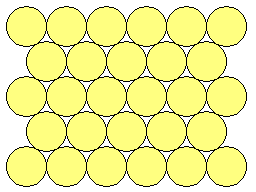
 This conventional plan view of the (0001) surface shows the hexagonal packing of the surface layer atoms.




.jpg)


